
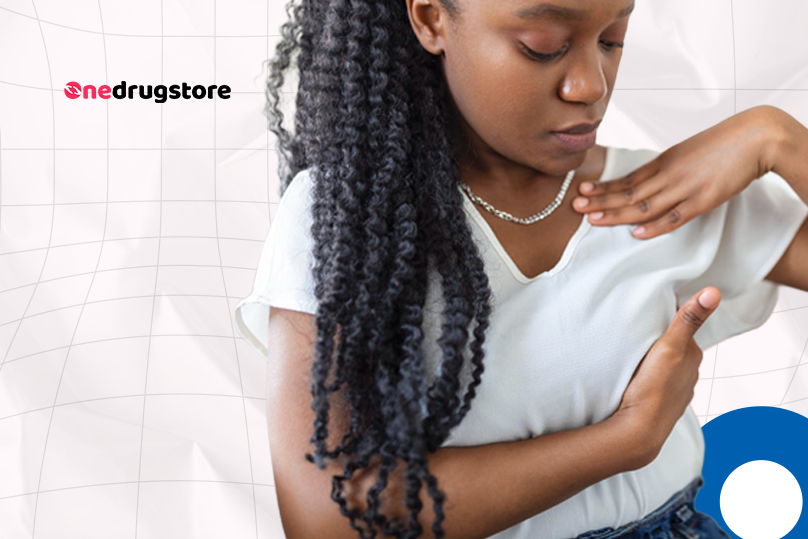
Breast cancer doesn’t send a calendar invite; it can affect anyone, anytime.
In Nigeria, more women are being diagnosed with breast cancer every year, and sadly, many cases are discovered late because people don’t know what to look for. But here’s the good news: early detection saves lives.
The most powerful tool you have is knowledge, specifically, knowing your body and understanding how to perform a Breast Self-Examination (BSE). A breast self-examination is a simple, hands-on way to check your own breasts for changes such as lumps, swelling, or differences in shape or texture.
At Onedrugstore, we believe in preventive health; BSE isn’t a replacement for clinical screening (like mammograms), but it’s a simple, no-cost, 5-minute habit that empowers you to find changes early, when treatment is most effective and successful.
1. What is “Normal”? Knowing Your Baseline
The goal of BSE is not to find cancer; it’s to notice if anything changes from your norm. Every woman’s breasts are unique. They can be naturally lumpy, dense, or uneven.
When to check: The best time is about 3 to 5 days after your period starts, when breasts are least likely to be swollen or tender. If you no longer have periods, choose the same day every month( for example, the 1st of every month).
2. Your Simple 3-Step Breast Self-Examination (BSE) Guide
Here’s the simple routine recommended by health experts, broken down into three easy phases:
Phase A: In Front of the Mirror (Visual Check)
What to do: Stand in front of a mirror with your arms at your sides, then raise your arms high overhead. Look for any changes in shapes, size, or symmetry.
What to look for:
- Any swelling or distortion
- Dimpling, puckering, or bulging of the skin
- Nipple changes (especially if a nipple is newly inverted or pushed inward).
- Redness, soreness, or rash around the nipple.
Phase B: Lying Down (Palpitation Check)
What to do: Lie on your back, placing a pillow or folded towel under your right shoulder. Use the pads of the three middle fingers of your left hand to examine your right breast.
The Technique:
- Use light, medium, and firm pressure in a circular motion (about the size of a coin).
- Imagine your breast as a clock face and examine it section by section, starting at the outside edge and moving inward toward the nipple.
- Be sure to check the entire area, from your collarbone down to your rib cage and from your armpit to your breastbone.
Phase C: In the Shower (Tactile Check)
What to do: Use the same finger pads and circular motion as in Phase B. The soapy water helps your fingers glide easily over the skin, making it easier to feel lumps or thickness.
Focus Area: Pay special attention to the area around your armpit, as breast tissue extends here, and the lymph nodes can swell.
3. When to See a Doctor: Symptoms to Never Ignore
Finding a lump during your BSE does not mean it is cancerous; it is usually a normal cyst or tissue change, but it must always be checked by a professional. Don’t panic, but don’t wait.
Consult a doctor immediately if you notice:
- A new lump or thickening in or near the breast or in the armpit.
- A change in the size or shape of the breast.
- Nipple discharge (fluid)
- Skin changes such as swelling, redness, scaling, or dimpling (like an orange’s skin).
4. Beyond the Self-Check: Clinical Screening
While BSE is a great start, women over the age of 40 should discuss formal screening methods with their doctor, including:
- Clinical Breast Exam (CBE): Performed by a healthcare professional during your regular check-ups.
- Mammograms: X-ray screening that can often detect abnormalities long before they can be felt. Talk to your doctor about screening frequency based on your personal risk factors.
Your Health, Your Power
Taking charge of your health starts with awareness. Making the breast self-examination a non-negotiable part of your monthly routine is the most proactive step you can take today.
